Why Carbon Black Is the Hardest Pigment to Disperse — And What That Means for Your Formulation
A technical perspective for colorant practitioners
COLORANTPUBLIC
Arif Sarwono
3 min read
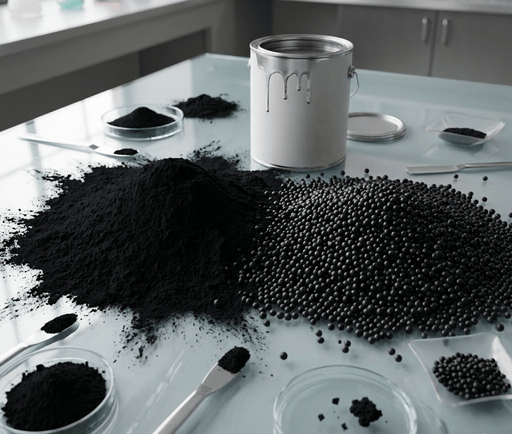
Every formulator who has worked with pigments long enough arrives at the same conclusion: black is the color that humbles you. A yellow or red pigment paste that fails is a problem. A carbon black dispersion that fails is a crisis — because it tends to fail in the most unpredictable, application-destroying ways. Viscosity spikes during grinding. Storage stability collapses after two weeks. Gloss is poor despite good fineness. Print density fluctuates across a single gravure job.
These are not random events. They are the predictable consequences of carbon black's unique physical and chemical character — a character that no other pigment in the palette shares to the same degree.
Three Properties That Drive All the Problems
Once you understand these three parameters, the dispersion challenges of carbon black stop feeling like bad luck and start feeling like physics.
Particle size is the most direct driver of jetness and tinting strength — and of difficulty. The finest furnace blacks used in high-end automotive coatings and gravure inks have primary particle diameters in the 10–15 nm range. For context, a typical organic pigment particle is 100–300 nm. The surface area of a 13 nm carbon black can exceed 300 m²/g. Every square meter of that surface must be wetted by your dispersant before meaningful stabilization can occur. This is why fine carbon blacks demand significantly higher dispersant loadings than any comparable organic pigment — and why under-dosing the dispersant is the single most common cause of dispersion failure.
Structure is the second critical parameter, Primary particles of carbon black do not exist in isolation — they fuse irreversibly during manufacturing into chain-like and branched aggregates. High-structure grades form complex three-dimensional networks in the liquid medium, entrapping large volumes of the carrier inside the void spaces of the aggregate. This dramatically increases the effective volume fraction of the pigment beyond what the weight fraction suggests, causing the viscosity of the mill-base to spike unpredictably during grinding.
Surface chemistry is the third parameter and the most nuanced. The carbon black are inherently non-polar. This is why carbon black is hydrophobic by default, why it prefers aromatic solvents, and why water-based systems demand dispersants with strong anchoring groups
Practitioners Know This Best
The severity of carbon black's dispersion challenges scales with the fineness requirement and the stress the dispersion faces in use.
In gravure printing ink, the combination of very low viscosity, very fine fineness requirements (typically below 5 microns), and the brutal shear environment of the doctor blade and engraved cell creates a perfect test of dispersion quality. A carbon black that is marginally stabilized will reagglomerate under doctor blade shear, producing streaking, inconsistent ink transfer, and density variation across a print run. The problem is compounded by the fact that gravure inks often use ketone or ester solvents that interact differently with the carbon black surface than the aromatic solvents the pigment actually prefers.
In masterbatch production, carbon black is processed at high temperature and high shear in the melt phase — an environment where there is no dispersant in the conventional sense, only the compatibility between the carbon black surface and the polymer matrix. High-structure blacks in polyolefin systems can cause melt flow issues, surface defects in the final article, and streaking or poor color consistency. The loading levels required for deep shade masterbatch push the system even closer to the edge of processability.
In water-based architectural coatings, the challenge is less about fineness and more about storage stability and rheology compatibility. Carbon black pastes that are not properly stabilized will thicken over weeks as the particles slowly reagglomerate, or will interact with associative thickeners in ways that produce unexpected viscosity profiles in the final paint.
What Good Dispersion Actually Requires
There is no shortcut. A well-dispersed carbon black system requires the right combination of four things working together:
The carbon black grade must be matched to the application — particle size, structure, and surface chemistry selected deliberately, not by habit or availability alone.
The dispersant must be polymeric, with sufficient molecular weight to provide steric stabilization, and must have anchoring groups with genuine affinity for the carbon black surface. In water-based systems, this typically means modified polyacrylate or polyurethane dispersants. In solvent-based systems, high-molecular-weight hyperdispersants with carbon-black-specific anchor groups outperform conventional surfactants significantly.
The grinding conditions — bead size, bead loading, tip speed, residence time, and mill-base concentration — must be engineered around the structure and particle size of the specific carbon black being used, not carried over from a formulation designed for a different pigment.
And finally, stability must be verified under stress — elevated temperature storage and shear stability testing — before a dispersion is considered ready. Carbon black is the pigment that will pass a one-week ambient storage test and fail catastrophically at 50°C after three weeks.
Understanding the physics behind the problem — particle size, structure, surface chemistry, and their interactions with the dispersion medium — is what separates a practitioner who manages carbon black from one who is managed by it.
Reach out anytime for chemical engineering or chemical application tips or discussion
Contact US
contact@mdm-technology.com
taramkt@gmail.com
+62811883915
+62818159065
© 2026. MDM Technology All rights reserved.