Pigment or Masterbatch?
What Injection Molding Manufacturers Need to Know
INJECTION MOLDINGPUBLIC
Arif Sarwono
4 min read
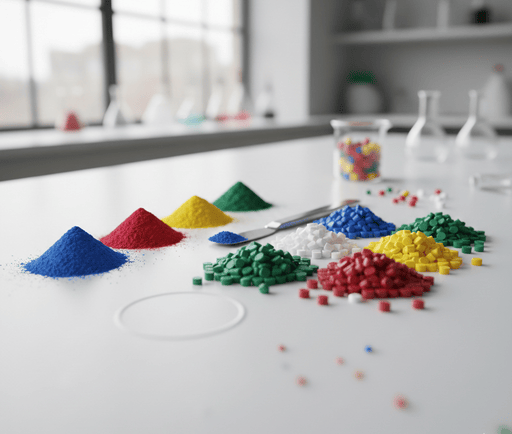
In the injection molding industry, the decision to use raw pigment or masterbatch for coloring plastic products is often treated as a cost issue. In reality, it is a production efficiency issue, a quality issue, and — for manufacturers supplying consumer houseware — a brand reputation issue. This article examines the technical and operational disadvantages of using raw pigment compared to masterbatch, and explains why the real cost of pigment is rarely reflected in the purchase price alone.
1. Dispersion Quality: The Root of Most Problems
Raw pigment particles are extremely fine powders. When added directly to a polymer melt without a carrier system, they rely entirely on the machine's screw and barrel to achieve uniform distribution. In most production conditions, this is insufficient. The result is color streaking, visible specks, and agglomeration on the surface of finished products.
Masterbatch solves this at the source. During masterbatch manufacturing, pigment is pre-dispersed into a carrier resin under controlled high-shear compounding conditions — a process far more intensive than any injection molding machine can replicate. By the time masterbatch enters the molding process, the pigment dispersion work is already done.
Analogy: Think of instant coffee versus raw ground coffee powder stirred into cold water. Raw powder clumps no matter how hard you stir — some areas are dark, others weak. Instant coffee dissolves uniformly because the pre-processing work was done earlier. In injection molding, those undissolved 'clumps' become visible defects on the surface of your product.
2. Dosing Accuracy: Where Small Errors Become Big Problems
Raw pigment is typically added at between 0.5% and 2% by weight. At these concentrations, a small error in manual weighing — even half a gram off — translates directly into a visible color shift in the finished product. This inconsistency becomes especially problematic in high-volume production where dozens of batches are run per day by different operators.
Masterbatch is typically dosed at 1% to 5%, offering a wider and more forgiving working range. Combined with consistent pellet form, the dosing process becomes significantly more accurate and less dependent on operator skill.
Analogy: Imagine a restaurant adding 2 grams of salt to each portion of soup by scooping from an open bag. Even with the same formula, every batch tastes slightly different depending on who is in the kitchen. Masterbatch is the pre-measured sachet — every portion is exact, regardless of who handles it.
3. Color Change Downtime: A Hidden Production Cost
When changing from one color to another, factories using raw pigment face a significantly longer purging process. Pigment particles penetrate deeply into screw flights, dead zones, and hot runner channels. A color change that should take 20 to 30 minutes can stretch to one or two hours, and contamination from the previous color may still bleed through into early shots of the next run.
Masterbatch, carried in a compatible resin matrix, is swept out of the system far more efficiently during purging. For factories running multiple color SKUs per day, the cumulative reduction in changeover time is substantial.
Analogy: Switching colors with pigment is like cleaning a thick foam roller full of red paint before painting with white. The pigment soaks into every pore, requiring repeated rinsing before white can be applied cleanly. Masterbatch is like cleaning a flat brush — a few passes and it is ready for the next color.
4. Screw and Barrel Wear: The Silent Maintenance Cost
Undispersed pigment agglomerates behave like abrasive particles inside the processing equipment. Over thousands of production cycles, this accelerates wear on the screw flight, barrel wall, and check ring. It also leads to faster screen pack clogging, which means more frequent shutdowns for maintenance. These costs accumulate quietly over months and years, and are rarely attributed back to the choice of colorant.
5. Thermal Stability: Risk During Residence Time
Raw pigments added without a stabilized carrier system are exposed to the full thermal stress of the injection molding process. During machine stops, slow production cycles, or any situation that increases material residence time in the barrel, unprotected pigments can degrade — causing color shift, yellowing, or in some cases, decomposition gases. Masterbatch formulations include heat stabilizers built into the carrier to protect pigment integrity throughout the process window.
6. Worker Health and Production Environment
Handling fine pigment powder in a production environment creates airborne dust that poses inhalation and skin contact risks to workers. For manufacturers producing food-contact houseware products, airborne pigment contamination on the production floor is also a compliance concern under food safety regulations such as FDA guidelines and EU Regulation 10/2011. Masterbatch eliminates powder handling entirely — the colorant is contained in solid pellet form from storage through to dosing.
7. Batch-to-Batch Consistency Across Production Runs
For manufacturers producing the same SKU over months or years — a standard red bowl, a signature blue container — color consistency across production runs is not a technical preference, it is a brand requirement. Raw pigment lot-to-lot variation, combined with dosing inconsistency, makes this difficult to achieve reliably. Masterbatch provides a standardized, qualified colorant with defined let-down ratios and color tolerances, enabling consistent output across any production run or production site.
8. The Real Cost Calculation
The purchase price of raw pigment is typically lower than masterbatch on a per-kilogram basis. However, a complete cost analysis must account for all of the following factors that pigment usage introduces:
• Increased rejection rate due to color inconsistency and surface defects
• Extended color changeover time and associated machine downtime
• Accelerated screw, barrel, and screen pack wear requiring earlier replacement
• Higher operator labor requirements for accurate weighing and mixing
• Potential regulatory compliance costs for food-contact product manufacturers
• Brand and quality risk from inconsistent color across production batches
When these costs are properly allocated, the true cost-per-kilogram of pigment-based coloring frequently exceeds that of masterbatch — particularly in operations with multiple daily color changes, tight quality standards, or food-contact requirements.
Conclusion
The choice between pigment and masterbatch is ultimately a systems decision, not a materials decision. The visible cost of masterbatch is higher. The invisible cost of pigment — in downtime, scrap, equipment wear, and quality inconsistency — is frequently higher still. For injection molding manufacturers competing on product quality and production efficiency, masterbatch offers a measurable and defensible advantage at every stage of the process.
Have a specific challenge in your production process?
All technical consultations and inquiries are treated as strictly confidential. Production details, formulation data, and business information you share are used only to serve your specific needs — never disclosed to third parties or supply chain partners without your consent. Reach out at contact@mdm-technology.com
Reach out anytime for chemical engineering or chemical application tips or discussion
Contact US
contact@mdm-technology.com
taramkt@gmail.com
+62811883915
+62818159065
© 2026. MDM Technology All rights reserved.