Dry Pigments or Color Preparations in Coatings
Why the Form of Your Colorant Changes Everything
COATINGPUBLIC
Arif Sarwono
2/21/20263 min read
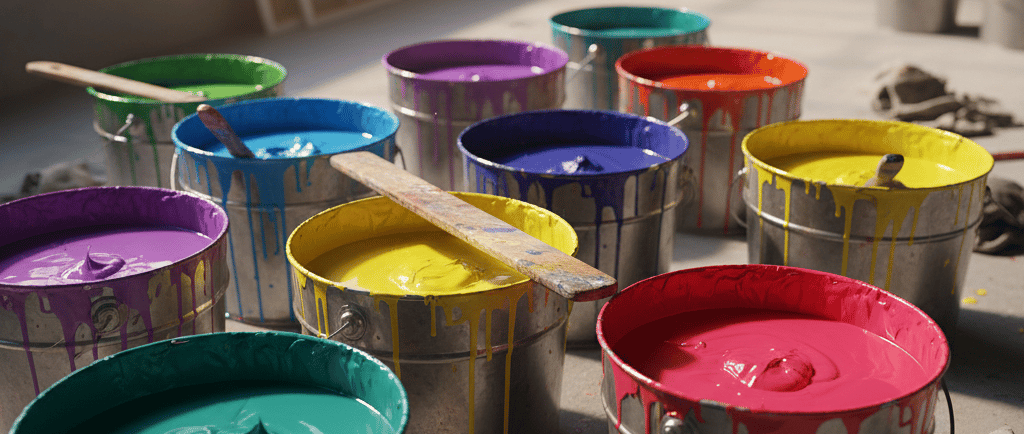
When formulators and technical buyers in the coating industry talk about color, the conversation rarely starts with the pigment itself — it starts with how that pigment is delivered. The choice between using a pigment preparation (also called a color concentrate, paste, or millbase) and a dry pigment is not merely a matter of convenience. It fundamentally shapes dispersion quality, process efficiency, final film performance, and ultimately, the color consistency your customer sees on their wall.
What Is a Color Preparation?
A color preparation is a pre-dispersed system where pigment particles have already been wetted, ground, and stabilized within a liquid carrier — typically water, a solvent, or a compatible resin. In water-based architectural coatings, these often take the form of aqueous pigment dispersions or universal colorants compatible with both solvent-borne and water-borne systems.
The key word here is pre-dispersed. The pigment agglomerates — those tightly bound clusters of primary particles — have already been broken down mechanically and locked in place by dispersing agents and stabilizers before the product ever reaches your mixing tank. This is work your production line does not have to do.
What Happens When You Use Dry Pigment Instead?
Dry pigments arrive as powders. Before they can deliver color, three sequential steps must occur inside your process: wetting, deagglomeration, and stabilization. Each step demands energy, time, and the right chemical environment.
Wetting is the replacement of air from the pigment surface with a liquid medium — in water-based paints, this is a battle because many pigments, especially organic ones, are inherently hydrophobic. Without sufficient surfactant or wetting agent, you get floating, flooding, or incomplete incorporation. Deagglomeration then requires mechanical shear — a high-speed disperser, a bead mill, or a rotor-stator — to physically break apart clusters. Miss the right fineness of grind, and you lose tinting strength, transparency, and gloss in the final film. Finally, stabilization must prevent re-agglomeration during storage.
In a typical architectural paint plant, achieving a quality dispersion from dry pigment demands dedicated grinding equipment, skilled operators, in-process quality checks (Hegman gauge, color strength testing), and significant time. Any inconsistency at this stage propagates directly into batch-to-batch color variation — the nightmare of every quality manager handling tinting systems.
The Technical Advantages of Color Preparations
Switching to a well-formulated pigment preparation delivers measurable advantages at multiple levels.
Dispersion quality is reproducible. The pigment manufacturer has invested in industrial-scale bead mills and optimized the grinding process with the right wetting and dispersing agents for that specific pigment chemistry. The particle size distribution is controlled and documented. When you pour a color preparation into your let-down resin, you are inheriting that quality — consistently, batch after batch.
Compatibility with emulsion resins is engineered in. For architectural coatings — acrylic emulsions, VAE (vinyl-acrylic), styrene-acrylic — the dispersing agents in quality preparations are selected for compatibility with the binder system. This matters enormously for flocculation resistance. A dry pigment dispersed in-house with the wrong additive package will often show viscosity shift, color drift upon application, or poor rub-out — signs of flocculation in the wet paint.
Process simplification is significant. Adding a preparation is typically a simple stirring step. No grinding, no Hegman checks, no risk of operator error in the grind phase. For small-to-medium architectural paint producers or tinting system operators, this translates directly to faster turnaround and lower reject rates.
Tinting system compatibility. The modern architectural market is heavily driven by in-store tinting systems, where a white or pastel base is tinted to thousands of custom colors using dispensing machines loaded with universal colorants. These colorants are pigment preparations — highly concentrated, stable, low-VOC aqueous dispersions. There is simply no viable dry pigment equivalent in this application. The precision dosing (often in grams or milliliters) that a dispenser achieves is only possible because the colorant is liquid, flowable, and homogeneous.
Where Dry Pigment Still Has a Place
Dry pigment is not obsolete. In high-volume commodity productions where the same color runs continuously, in-house grinding can be cost-effective once the process is mastered. Inorganic pigments — titanium dioxide, iron oxides, chrome oxide — are generally more forgiving to disperse than organics and are sometimes used as dry additions in specific formulation stages. Some specialty effects (metallic, pearlescent) also arrive as dry powders or pastes where the preparation format is less established.
But for most architectural paint producers, especially those running flexible tinting operations or launching into premium emulsion paint segments, the economics tilt toward preparations when you account for the full cost: equipment depreciation, energy, rejects, QC labor, and the hidden cost of color complaints in the field.
Practical Considerations for Formulators
When evaluating a color preparation for an architectural application, look beyond the color chip. Ask for the particle size distribution (D50, D90), the pH, the viscosity profile over time, and critically — the compatibility data with your specific binder system. A dispersant optimized for a solvent-borne alkyd will behave very differently in an acrylic emulsion. The best preparation suppliers will provide Hansen Solubility Parameter data or at minimum an empirical compatibility table with common binder chemistries.
Also evaluate VOC content — increasingly critical for architectural coatings under green building standards and indoor air quality regulations. Quality aqueous preparations are now available with near-zero VOC, while some solvent-based grind vehicles would compromise your formulation's compliance profile.
Reach out anytime for chemical engineering or chemical application tips or discussion
Contact US
contact@mdm-technology.com
taramkt@gmail.com
+62811883915
+62818159065
© 2026. MDM Technology All rights reserved.