

Choosing the Right White Colorant for Silicone Sealant
What the Label Doesn't Tell You
COLORANTPUBLIC
Arif Sarwono
5 min read
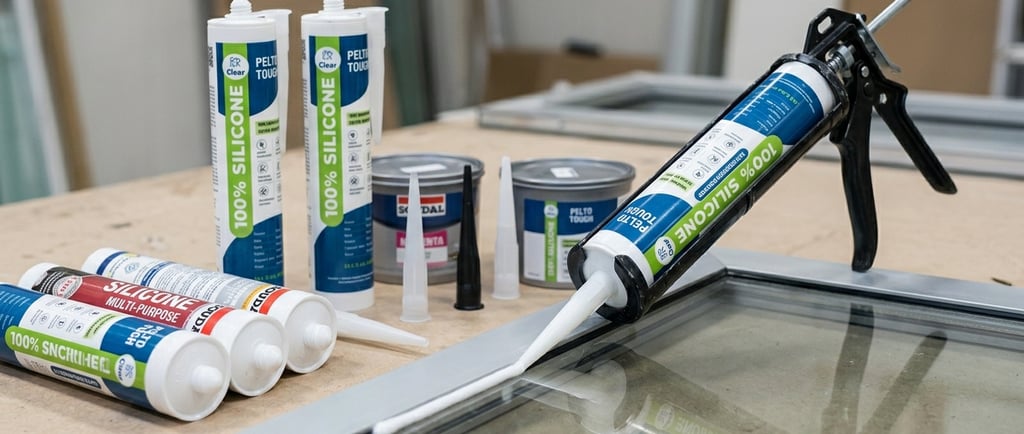
Walk into any hardware store and the sealant shelf is overwhelmingly white. That white comes from titanium dioxide — rutile TiO₂ — dispersed in a carrier and added at the final stage of sealant production. Simple enough in concept. But the colorant sitting in your drum or on your shelf is far from a commodity. The form it comes in, what carries the TiO₂, and how it behaves in your mixer all have measurable consequences for your formulation, your production consistency, and your total cost per kilogram of finished sealant.
This article walks through what actually matters when evaluating a white colorant for silicone sealant — technically, commercially, and operationally.
What Is Inside a Silicone Colorant?
At its core, a white silicone colorant is TiO₂ dispersed in a carrier. The carrier determines everything else: the colorant's physical form, its compatibility with your sealant base, how it behaves during storage, and how it interacts with your crosslinker package.
The two most common carrier types in the market are low molecular weight PDMS oil (typically 350–1,000 cSt) and high molecular weight PDMS gum. A liquid colorant uses PDMS oil — the result is a flowable paste that can be pumped, metered, and added directly to the mixer. A cake or masterbatch form typically uses a gum-based or more complex matrix — the result is a solid or semi-solid block that must be manually broken, scooped, and dispersed under shear before it incorporates into the sealant.
The TiO₂ loading in both forms is typically in the 35–45% range by weight. Beyond that, the two systems behave very differently in practice.
Dispersion Quality: The Real Driver of Opacity
Opacity is not simply a function of how much TiO₂ you add. It is a function of how well those TiO₂ particles are separated from each other in the final film.
Rutile TiO₂ scatters light most efficiently when its primary particles (0.2–0.3 μm) are individually spaced at roughly one particle diameter apart — a condition known as optimal inter-particle spacing, grounded in Mie scattering theory. When TiO₂ particles agglomerate into clusters of 5 μm or larger, they scatter light as a single large particle, not as multiple individual particles. The opacity per gram of TiO₂ drops significantly.
This is why two colorants with nominally identical TiO₂ content can perform very differently on a drawdown. The better-performing product is not necessarily the one with more TiO₂ — it is the one whose TiO₂ is better dispersed and more stable against re-agglomeration during storage.
Hegman fineness is your practical diagnostic here. A Hegman reading of 7.0–7.5 (corresponding to maximum particle size of approximately 6–12 μm) indicates acceptable dispersion for most sealant applications. Readings below 6.5 suggest agglomerate survival — and a corresponding opacity penalty at equal dosage.
The Moisture Problem Nobody Talks About
Every silicone colorant carries some moisture. In a neutral-cure or alkoxy-cure sealant system, this matters more than most formulators account for.
Moisture competes directly with the crosslinker — whether oxime silane, alkoxy silane, or acetoxy silane — for the same reactive sites. Every gram of water introduced into your sealant batch consumes crosslinker before it can contribute to the cure network. The result is reduced crosslink density, lower mechanical strength, and shortened shelf life in sealed cartridges.
A liquid colorant based on PDMS oil, stored properly in sealed drums, typically carries 0.05–0.15% moisture. A cake-form colorant — particularly one based on a hygroscopic carrier — can carry 0.40–0.50% moisture. At a 3% dosage into 100 kg of sealant, the difference is approximately 10 grams of extra moisture per batch. In a tightly optimized formulation, that margin is not trivial.
If you are troubleshooting shelf life inconsistency or variable cure depth between batches, incoming colorant moisture content is worth adding to your incoming QC checklist.
True Cost: Beyond the Price per Kilogram
The purchase price of a colorant is the starting point for cost comparison, not the endpoint. The more useful metric is cost per kilogram of finished sealant produced — and this requires accounting for what the colorant contributes beyond TiO₂.
A liquid colorant based on 60% PDMS oil delivers a significant quantity of silicone plasticizer directly into the sealant when added at 3% dosage. At that loading, approximately 1.8 kg of PDMS oil enters every 100 kg batch via the colorant. If your formulation already specifies a PDMS plasticizer, this contribution is substitutable — you reduce your plasticizer addition by the same amount without changing your sealant's rheological or mechanical profile.
At typical PDMS oil market prices, this substitution is worth approximately USD 4.50–5.00 per 100 kg of sealant produced. When this offset is applied, a liquid colorant priced nominally higher per kilogram than a cake competitor can result in a lower net cost per kilogram of finished sealant. This calculation is straightforward to run with your own formulation data — and it is a more honest basis for supplier comparison than headline price alone.
Production Consistency: The Hidden Variable
Colorant performance in the lab and colorant performance across a production month are two different things. The gap between them is largely a function of the colorant's own batch-to-batch consistency.
A liquid colorant with defined viscosity specifications (for example, 2,000–3,000 cP at 25°C) and colorimetric specifications (dE < 1.0 vs. reference) gives your QC team measurable incoming parameters. Viscosity can be checked in minutes with a Brookfield. dE can be confirmed with a simple drawdown and spectrophotometer. If a drum is out of spec, you know before it enters the mixer.
A cake colorant has no equivalent measurable flow property. Its consistency is inherently tied to its production process — mixing intensity, temperature, and cooling rate all affect the cake's hardness and TiO₂ distribution. Batch-to-batch variation manifests as dosage uncertainty: the same mass of cake may disperse differently depending on its internal structure. The downstream symptom is color or opacity variation in your finished sealant that is difficult to trace back to its source.
If your production line uses automated dispensing or gravimetric dosing, liquid colorant is compatible by design. Cake colorant requires a manual scooping step — and with it, the operator variability that comes with any manual process.
What to Measure When Evaluating a Colorant
Whether you are qualifying a new supplier or auditing an existing one, the following parameters give you a complete picture:
TiO₂ content — gravimetric ashing at 600°C. This is your primary active content measurement. Note that PDMS oil contributes a small SiO₂ residue at 600°C, so interpret ash results in the context of the carrier type.
Specific gravity — by pycnometer or dilution method. This cross-validates TiO₂ content and carrier identity. For a 40% TiO₂ in PDMS oil system, expect SG approximately 1.35–1.45.
Viscosity — Brookfield at 2 rpm and 12 rpm, 25°C. The ratio of these two readings gives you the thixotropy index — a useful indicator of dispersion quality and storage stability.
Hegman fineness — ASTM D1210. A minimum of 7.0 is recommended for sealant applications.
Moisture content — gravimetric at 105°C/3 hours. Target < 0.20% for liquid systems.
Opacity in your sealant — CIE L*a*b* on a drawdown at your standard dosage. This is the ultimate functional test, and it should be run in your own sealant base, not a third-party substrate.
Conclusion
White colorant selection for silicone sealant is a formulation decision, not a procurement decision. The carrier type determines moisture contribution, process compatibility, and storage behavior. Dispersion quality determines opacity efficiency — and opacity efficiency determines how much colorant you actually need. True cost is a function of all of these factors together, not of the number on the invoice.
The most reliable colorant for your process is the one you can measure incoming, trust to perform consistently, and account for fully in your formulation balance. Start with those criteria, and price comparison becomes much simpler.
This article reflects findings from comparative colorant analysis conducted in a silicone sealant formulation context. Specific performance data referenced is based on laboratory evaluation under controlled conditions.
Have a specific challenge in your production process?
All technical consultations and inquiries are treated as strictly confidential. Production details, formulation data, and business information you share are used only to serve your specific needs — never disclosed to third parties or supply chain partners without your consent. Reach out to Arif Sarwono at contact@mdm-technology.com
Reach out anytime for chemical engineering or chemical application tips or discussion
Contact US
contact@mdm-technology.com
taramkt@gmail.com
+62811883915
+62818159065
© 2026. MDM Technology All rights reserved.